-
0 Competing: One Path Along the Way
- Blog
- by Administrator
- 05-08-2026
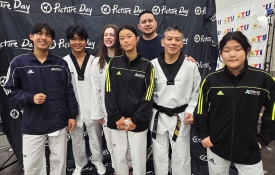
5.00 of 1 votesCompetition is an exciting part of martial arts, but it is not the most popular path. Many students will train for years, building confidence, discipline, and self-control without ever stepping onto a competition mat. Arguably, one of martial arts most important lessons is how to resolve conflict and avoid violence altogether. But for students and athletes who do choose to compete, it is an opportunity to grow. For some, competition can help build focus, resilience, and respect. It’s not just about winning. It’s about learning, improving, and showing up to do your best. Learning from Our Competitors We asked the senior members of our competition team, Ava Anderson, Luke Park, and Master Van Rex Lamsen what competing means to them. Ava Anderson shares what her thought process is like right before a match: “...I go over the plan that I have with my coach in my head before I go out on the mat. I remind myself that even if I lose it doesn't mean that I am a terrible athlete and that I'm a bad fighter. I remind myself to not hyperfocus on the other fighters in my division and focus on what I can do to win. When asked to consider her strongest advantage over opponents, Ava knew the answer immediately. “My discipline and my work ethic. Forcing myself to really dedicate the majority of my time to taekwondo and make it a way of life....has really changed how I fight and interact with other fighters outside and inside the ring. Ava also encourages students to focus on themselves. “Have confidence in how you fight. This is the most important part of fighting. Imposter syndrome is your worst enemy.... If you think and truly believe that you aren't good enough and you don't deserve to be there, you will fail, and your wins won't feel like wins. ... Feeling confident in your ability no matter who you are fighting, is crucial to doing well.” For Luke Park, consistency matters most. “The biggest habit that gives me an advantage over other competitors is consistency. Consistent hard work beats talent any day.” He reminds newer students to be patient, that results take repetition. “A beginning student might believe that competing will bring immediate results. This is hardly the case. It might be a while before you even win a match at a tournament, and that's okay. Like Ava, Luke emphasizes the importance of mindset. “....That might seem like a cliche, but it truly is a process. You are never going to win everything, feel good every time, or perform well everyday. There are going to be ups and downs throughout your time competing, but that's all natural. You might not see it at the moment, but you have to trust that your overall trajectory is gradually going up.” Luke also emphasizes the importance of training beyond the physical techniques. “Mentality, I would argue, is actually just as important, if not more important, than your physical ability. Things like visualization, self-talk, and having a "I truly believe I can do it" attitude are some things that are essential to long-term success. Your mentality completely changes how you fight.” By now, you may notice the pattern Competitors in all sports and categories can attest to the importance of a resilient mentality. “Indominable spirit” is a core tenant of taekwondo, and the ability to push forward through adversity is a tell-tale sign that a person has trained martial arts. When asked what habits give him an advantage over his opponents, Van Rex Lamsen prefers to keep it simple: “No specific habits in particular. I try to train on a regular schedule at least 2-3x/week if not more and watching my diet, avoiding junk and sweets....When competition is close I take a couple of days off work to relax, mentally prepare, and get to the gym for a light workout.” But competing, like life, is never a predictable road. “When getting pushed back, I try to battle back and learn from it. Whether it’s losing a match or sustaining an injury, making the proper adjustments and moving forward. Giving up is not an option...” As a veteran competitor, Master Lamsen offers a unique insight into the journey of a competing martial artist, “...I try to have fun and enjoy the sport I’ve been doing since I was a teenager.” More Than Medals While we celebrate these achievements, we are most proud of the effort, teamwork, and perseverance behind them. Every student who steps onto the mat shows courage. Whether competing or training for personal growth, martial arts helps students become stronger, more confident, and more resilient. On the mats, and in everyday life. Celebrating Our Recent Tournament Success We are proud of our students and instructors for their outstanding performances: USAT Massachusetts State Championships Ava Anderson – Gold Luke Park – Gold AAU New England Championships Master Jay – Gold Ava Anderson – Gold Luke Park – Gold USAT New Jersey State Championship Ava Anderson – Gold Luke Park – Bronze US Open – Las Vegas, NV Master Lamsen – Gold Zita Erdei – Gold Ava Anderson – Bronze AAU NY Metro Championships Master Lamsen – Gold Ava Anderson – Gold Oliver Cobos – Gold Maxim Cohen – Gold Chloe Chen Lai – Gold Alea Ndreshaj – Gold Zita Erdei – Gold Victoria Yao – Silver Elena Uribe – Silver Luke Park – Bronze Canada Open Ava Anderson – Gold
-
0 Can Sparring Be Taught in a Way That Is Both Safe and Fun?
- Blog
- by Administrator
- 02-03-2026
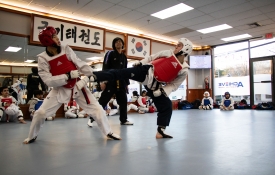
5.00 of 1 votesA common question for new martial artists is also a question that is not discussed enough. Can we make the process of learning to spar one that is fun but also functional and safe? In martial arts like taekwondo, sparring often means two students practicing with each other, not to fight, but to learn timing, control, and respect for an opponent. One key idea: if we set things up right — with clear rules, good gear, and a friendly attitude — then sparring becomes a positive part of growth instead of a risk. Studies show that martial arts training in youth can improve physical fitness, coordination, and self-control. For example, a systematic review found that children participating in martial arts programs showed improvements in cardiorespiratory fitness, strength, agility, balance, and coordination. DOAJ+1 This suggests that when sparring is part of a well-structured program, the benefits ripple out beyond just kicking and punching. It’s also important to realize that while sparring has benefits, the risk of injury must be managed. One clinical report on youth in martial arts noted that contact-based sparring with competitive conditions carries a higher risk of injury than non-contact drills. What we learn from that is: safety doesn’t mean “never spar,” it means “spar smart.” Good coaches adjust the level of contact, emphasize correct form, use protective equipment, and ensure students are matched fairly (in terms of age, size, and skill). The research supports that approach. So how do we make sparring fun and safe? First: mindset. If students see sparring as a game of skill, respect, and learning — rather than “who wins this fight” — the atmosphere shifts. A recent pedagogical paper described how sparring can be framed cooperatively, so that partners help each other improve rather than simply competing against each other. Second: structure. Set clear rules (e.g., no strikes to the head, controlled speed), use appropriate gear, monitor fatigue, and make sure everyone knows the “why” behind what they’re doing. Third: progression. Start with light, controlled sparring, build skill, then increase the challenge when the student is ready. Fourth: fun. Include variation, make it a game, show progress, celebrate improvement. When kids laugh, cheer for each other, and see themselves getting better, that positive feeling makes learning stick. Ultimately, yes — sparring can be taught in a manner that is both safe and fun. It requires thoughtful planning, strong supervision, and a community mindset that places growth over winning. When done well, the long-term benefits for young students go beyond martial arts: better coordination, stronger bodies, improved self-control, and more confidence. Let’s help our students spar, learn, and smile together. SOURCES: Articles – DOAJ https://doaj.org/article/f5441542f18d45f5aac8d67c09d2f7f4 Sparring And Neurological Function In Professional Boxers – DOAJ Youth Participation and Injury Risk in Martial Arts - PubMed
-
0 Achieve Martial Arts Staff Earn Spots on the USA National Team
- Blog
- by Administrator
- 02-03-2026
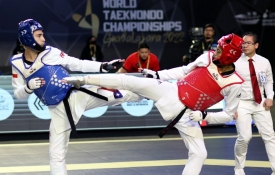
5.00 of 2 votesWe are proud to announce that four athletes on our Achieve Competition Team have officially earned their place on the USA National Team for AAU Taekwondo! After a year of relentless training and focus, they first captured gold at Nationals in Utah, qualifying them for the prestigious National Team Trials. There, they once again demonstrated their skill and determination, winning their divisions and securing their spots on the team. Among them, Master Van Rex Lamsen, a 3-time National Champion, and Master Sean Laloan, a 7-time National Champion, are longtime students and instructors at Achieve Martial Arts. They have represented both their school and the sport of Taekwondo with dignity and pride, serving as role models for the next generation of martial artists. We extend our heartfelt congratulations to Master Van Rex Lamsen (80kg Ultra), Master Sean Laloan (80kg), Instructor Sheldon Wilcox (68kg), and Master Brandon Ramos (58kg). Their commitment to excellence is an inspiration to us all, and we cannot wait to see them represent our school and the United States on the international stage.
-

- Blog
- by Administrator
- 09-01-2023
3.67 of 3 votesIn addition to physical training, Taekwondo imparts essential principles through its Five Tenets. Martial Arts instills values that empower us with self-confidence, reinforcing the belief that we can accomplish anything with courage and the right mindset. The Five Tenets of Taekwondo are: Courtesy (예의) - Embrace kindness and compassion, expressing them with sincerity. Integrity (염치) - Uphold honesty, acknowledging your mistakes and striving never to repeat them. Perseverance (인내) - Maintain unwavering determination, refusing to give up and consistently completing what you start. Self-Control (극기) - Exercise command over your emotions and behaviors. Indomitable Spirit (백절불굴) - Act fearlessly against injustice, championing freedom, and always choosing to do what is right, regardless of the challenges. Please share with us if any of these tenets have positively impacted your life.
-

- Blog
- by Administrator
- 07-28-2023
5.00 of 1 votesUSA Tae Kwon Do Nationals!The competition to figure out who's the best Sport Tae Kwon Do practitioner in the United States! We had 8 students go out to this event in Florida this year, and we came back with 5 medals!A feat they should all be proud of, it was a great event, and we hope to bring back more next year! After a bit of R&R, our students are already practicing for next year, making sure they improve their game!Tournaments, regardless of being on the national scale or local, are a great place to put oneself out there. For both coaches and students, we're all always learning and can learn from each other. Other students and coaches from other schools may have a unique way of training that you may be able to discern. They may have even thought up new variations of kicks to use. Sure, if it's the first time you see it, you may lose to them, but it's something you can put to use next time! A fish in a small pond will always think that that pond is the whole world. So go out there, find a local tournament, allow yourself to experience things outside of your own school, and put to test what you've learned!
-

0 Why do we remove our shoes at the Taekwondo School?
- Blog
- by Administrator
- 12-14-2022
4.00 of 2 votesIn Taekwondo, it is customary to remove your shoes before entering the training area or Dojang. This practice is based on traditional Korean customs, as well as practical considerations. In Korean culture, it is considered impolite to wear shoes indoors, as they can bring in dirt and germs from outside. Removing shoes before entering a home or a sacred space is a sign of respect and cleanliness. Taekwondo Dojangs are considered sacred spaces where students can learn and practice the art in a clean and safe environment. Additionally, removing shoes also helps to keep the training area clean and free of debris that can be hazardous during training. Taekwondo involves a lot of movement, including jumping, kicking, and rolling, so a clean and safe training environment is essential.
-

- Blog
- by Administrator
- 12-02-2022
4.50 of 2 votesThe Black Belt is a martial artists' biggest goal, leading to the common question of “How can I get my next belt?” The requirement for leveling up is simple: Along with memorizing the curriculum, students must do their best in class, show respect to fellow students and instructors, and be consistent. The higher the belt rank, the harder the techniques become. Students will be challenged with board-breaking techniques, sparring matches, and fitness tests as well. Despite the importance of the belt rank is the journey and process of becoming a black belt. As Gunnar Nelson said, “A black belt doesn't mean anything. The meaning is in the journey.” With convenient locations in Scarsdale, Yonkers, and Portchester, it’s easy to start your journey with Achieve Martial Arts. Come see why we have the best program in Westchester County.
-

- Blog
- by Administrator
- 11-16-2022
5.00 of 2 votesMartial Arts goes beyond just learning self-defense. Children who practice Taekwondo build self-confidence, are able to focus better all while getting a full body workout. If you are looking for Martial Arts classes, we invite you to visit our school. We are Westchester’s choice for Martial Arts. Call us and schedule a Free Introductory Lesson today! Yonkers Achieve Martial Arts: (914) 222-9532 Scarsdale Achieve Martial Arts: (914) 723-0777
-

0 BE THE MASTER OF YOUR EMOTIONS
- Blog
- by Administrator
- 09-28-2022
5.00 of 1 votesMartial Art is a powerful tool for regulating and validating students’ emotions while teaching them how to connect the body and mind. Many students at Achieve Martial Arts started the program struggling with anxiety or having problems controlling their own emotions. By practicing Taekwondo they were able to learn how to put their minds in the right place and develop greater emotional stability. Beyond that, the exercise also provides a big boost of “feel-good” hormones - releasing endorphins during training. Practicing Martial Arts is an awesome tool to learn how to be the master of your own emotions. Come try us out either in Scarsdale or Yonkers.
-

- Blog
- by Administrator
- 08-31-2022
5.00 of 2 votesAchieve Martial Arts is dedicated to making everybody’s experience enjoyable. With a clean facility, the staff welcome all students to class and create personal connections with them - creating a family-like culture. In class, students are taught discipline but also rewarded with plentiful fun. There are classes for all ages, making it a spectacular choice for anyone to begin their martial arts journey. If you would like to start yours, give it a try and schedule a free introductory lesson with us! Please call: Yonkers location: 914-222-9532 Scarsdale location: 914-723-0777.